

10 September 2026 — Writing
Gemma Rolls-Bentley on Bugarin + Castle’s Shame Parade at the Venice Biennale
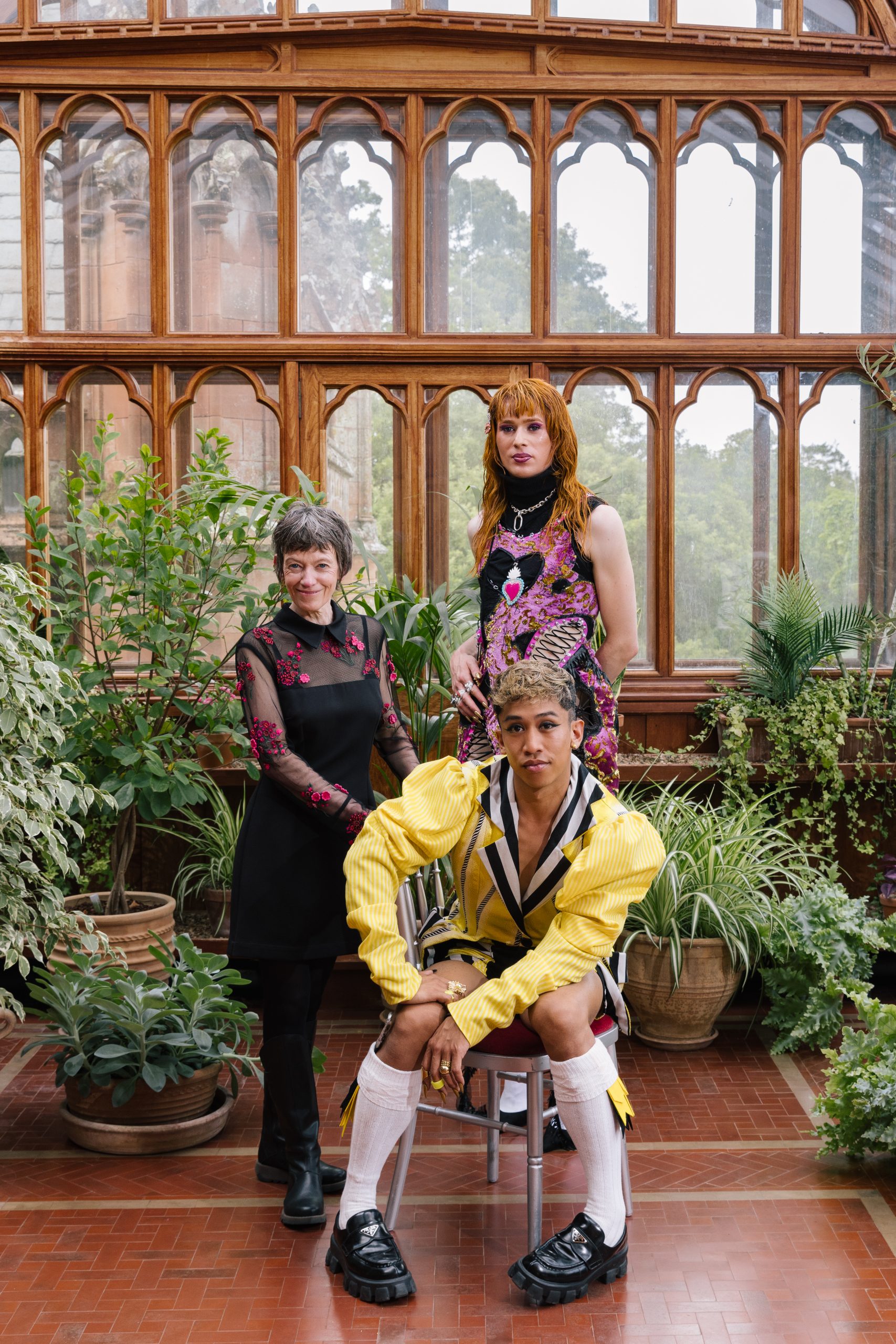

For me, Bugarin + Castle are quite easily the standout artists at this year’s Venice Biennale. Both young and right at the beginning of their collaborative artistic career, Davide Bugarin and Angel Cohn Castle first crossed paths in Edinburgh, where they were both performing in the city’s queer cabaret scene. Now based in Glasgow, they are a romantic duo as well as an artistic one. Spending even a fraction of time with them, it quickly becomes obvious that the collaborative nature of their creativity spills into absolutely every aspect of their lives, right down to helping each other pick out their clothes. They speak with a deep, mutual respect for each other’s individual practices and what each brings to the table, alongside an enthusiasm for the sheer creative power of their collaboration, a dynamic they perfectly describe as an “uneasy and passionate duo.”
Their Venice presentation, Shame Parade, which draws connections between queer and trans lives in Scotland and the Philippines, where Davide lived until the age of 8, is supported by Mount Stuart Trust and Forma, two major UK arts organisations that have championed the artists previously. At the pavilion’s launch event, Sophie Crichton-Stuart, Chair of the Mount Stuart Trust, and Chris Rawcliffe, the Artistic Director of Forma, both spoke with palpable passion about the pair and their vision. Julie Lomax, CEO of a-n, also said a few words about Bugarin + Castle’s presentation, making a crucial point about exactly why it matters that artists are claiming platforms as major as the Biennale to share queer and trans perspectives.
And she is absolutely right. The artists are certainly not short of champions, but they are making work at a time of rising, insidious hostility. We are watching right-wing governments attempt to restrict freedom of creative expression, while the actual safety of queer and trans people who simply want to live and make work openly is actively threatened. You can’t really ask for a more mainstream, global art audience than the crowds at the Venice Biennale, and Bugarin + Castle have seized this opportunity to share queer and trans lived experiences with people outside of the community.
Shame Parade should be considered as a whole. It is a deeply cohesive installation where architecture, moving image, sculpture, and performance all bleed into one another, anchored by recurring motifs of shame, falling, and public vulnerability. Conceptually, the commission takes the medieval history of shaming rituals, specifically the European tradition of charivari, as a starting point. During charivari, neighbours would mock social transgressors, such as ‘unruly’ women rumoured to have disobeyed their husbands, emasculated men, sex-workers, or ‘powerful and athletic’ women, with discordant noise and satirical cross-dressing. Exploring how sound and costume have historically been weaponised as tools of social control, Bugarin + Castle flip the tradition of shaming rituals through a contemporary queer and trans lens. As the duo brilliantly put it: “We make the work in a context today where the lives of those such as trans people and sex workers are being debated and impacted in courts and parliaments, often without those people being heard. The work does not tidy shame away, nor does it cling to it. Instead, we lean into complexity and stickiness.”
Before reaching the video piece at the centre of the exhibition, you have to walk through an environment that immediately shifts your reality. The very first piece you meet is hung cleverly and rather confrontationally right at eye level. Titled At Certayne Tymes (2026), it is a functioning ‘clocking clock’ that hangs in the space like a rogue planet or a sci-fi spaceship, which can be viewed in the round. As the mechanism ticks, the clock face reveals an Adam’s apple on a trans woman’s neck. It is a direct reference to the concept of being ‘clocked’ as trans in public. On the surface, the piece feels fun, highly designed, and a bit tongue-in-cheek with its fake gems and nail art paint, but the undertone is incredibly sinister.
To be clocked is a serious, sometimes fatal, risk. Trans women are arguably the most vulnerable demographic in today’s society; in recent years, hate crime data has repeatedly shown terrifying spikes in violence against trans people. This climate of fear isn’t isolated. It brings to mind the razor-sharp commentary in Russell T Davies’ recent Channel 4 drama Tip Toe. In the show, the characters observe how the toxic, anti-LGBTQ+ rhetoric boiling over in American politics gives people across the world free rein to unleash their own bigotry, perfectly captured by the chillingly accurate line: “the president of America has given these men permission to attack us“. Being clocked is not a game, and the tension of that ticking clock perfectly captures the anxiety of public visibility in a world that feels increasingly hostile.
Davide’s background in architecture acts as the scaffolding for how the pair articulate their ideas in three dimensions. At the centre of the space sits Nocturnal Amusements (2026), a large-scale sculptural intervention that features a forced-perspective viewing tunnel. When you peer down the tube, you are met with a 3D-modelled miniature diorama that merges a medieval shaming parade with the Manila North Cemetery. The aesthetic of the viewing platform borrows heavily from Filipino jeepney vehicle art. Interspersed among hand-painted signs and vinyl prints, the artists have hidden images of queer and trans people in ‘shushing’ poses next to the text: “Are You Discreet?” It is a brilliant provocation about the survival tactic of staying hidden.
Tucked quietly behind this piece is a collection of objects titled Pride Debris. Gathered by the artists at various Pride parades across Scotland in 2025, the debris highlights the messy clash between grassroots campaigning and sterile corporate sponsorship. This fleeting archive of an ongoing movement immediately calls to mind the work of Hannah Quinlan and Rosie Hastings, another romantic and artistic duo, whose cork board installations and video work of the last decade brilliantly archived the flyers and banners of LGBTQ+ nightlife. It also echoes the vital work of the Museum of Transology, which regularly invites community curators to collect signs from Trans Pride marches to be archived at the Bishopsgate Institute. Bugarin + Castle are asking the same big questions: what is the legacy of these ephemeral moments of protest? How does queer and trans existence link to the wider socio-political landscape, both locally and globally?
The figures from the medieval diorama are actually lifted from William Hogarth’s 18th-century engraving Hudibras Encounters the Skimmington. These same figures reappear on a set of acrylic nails gripping the edge of a striking digital print hung near the video installation. Bugarin + Castle worked with a local trans nail artist to realise these spectacular talons, they’re giving nail art x100, which speaks so beautifully to the meticulous care, the quiet labour, and the fierce artistry that goes into the deeply intentional act of shaping how the world sees you.
The print features a trapdoor at its centre, rendered in a way that forces your gaze straight down into it – a bit Escher-esque, a bit David Bowie’s Labyrinth, and brought to life with a digital slickness heavily reminiscent of The Matrix. The trapdoor serves as a site of both intense danger and sudden emergence, playing with themes of falling and Alice-in-Wonderland-style sliding doors moments. Significantly, the artists are reclaiming the word ‘trap’, a vile slur weaponised against trans women, and turning the trapdoor into a portal that allows them to escape pre-determined, linear timelines.
This trapdoor motif also appears in Submit to Sound (2026), an ambitious 20-minute, 5-channel film, at the center of the exhibition. The narrative shifts fluidly across time and space, following a trans woman named Sadie as she undergoes voice feminisation therapy, alongside stunt doubling and roleplay training. From beneath a trapdoor, a character named Mr. Mimic appears, echoing Sadie’s clothes and sounds in a performance that constantly swings between mockery and genuine empathy. We also see two singers from the Manila-based band Kalye Teresa projecting their voices through medieval arrow slits, their songs weaving in historical accounts of cross-dressed shaming. The music featured here is incredibly powerful; it acts as the perfect accompaniment to the film’s striking visual imagery, elevating the entire experience into an almost spiritual realm.
The foundation for this film, and the wider exhibition, actually grew from a sound-mapping exercise that Davide conducted at the Manila North Cemetery, a place that hums with traffic, karaoke, and life by day, but falls dead quiet at night. Unbelievably, the word charivari is still actively embedded in noise restriction legislation in the Philippines today. By pulling this historical European shaming tactic through time and geography to modern-day Manila and contemporary queer culture, the artists establish voice and sound as contested tools of both control and liberation.
Shame Parade is a triumph. It is deeply sensitive and personal, yet executed with an astonishing level of technical sophistication and serious skill. Bugarin + Castle have not just created an exhibition about queer survival; they have built a time-looped, conceptually rigorous world that holds both tension and joyous creativity. By mapping shame and transformation across centuries and continents, they have made a serious, lasting contribution to British and global art.
Essay by Gemma Rolls-Bentley.
Gemma Rolls-Bentley has been at the forefront of contemporary art for two decades, working passionately to champion diversity in the field. Her latest publication Art Essentials: Queer Art, coauthored with Mollie Barnes, was published by Thames & Hudson in April 2026. Her debut book Queer Art; From Canvas to Club and the Spaces Between is a Lambda Literary Award finalist and has been highlighted as a must-read by Them, Dazed, Timeout, The Guardian, Cultured and the FT. Her curatorial practice amplifies the work of female, queer and trans artists and provides a platform for art that explores LGBTQIA+ identity. Gemma has curated for a range of international galleries and institutions, most recently Dulwich Picture Gallery, Alice Austen House Museum, ICA London, Wolterton, and the Leslie Lohman Museum of Art. Gemma has taught at numerous institutions including the Royal College of Art, Glasgow School of Art, and Goldsmiths, and was a juror for the 2025 John Moore’s Painting Prize. She sits on the Courtauld Association Committee and the Leslie Lohman Museum Acquisitions Committee.