

16 October 2026 — Writing
morning star mace by Adam Benmakhlouf
A dark corridor on arrival becomes throat walls as gulping noises play along its narrow green-lit passage leading to Bugarin + Castle’s Venice presentation. ‘Autophony’ is the relevant term for hearing my own biological functioning: creaking, pulsing organs and bones from within. This audio work makes the building a body; sound an analogue of physical sensation. Verdant gardens outside become the acidic green glow of a windowless club, close and warm as Italian summer. Pressing of flesh and flesh to move liquid from inside mouth and downward is amplified. One step of remove is undone, the distantiation of me from it from you; lit in chartreuse. Is this the intimacy of encroachment?
When entering the bright open, roomy main space, steady swallowing turns into ticking from the suspended metallic clock sculpture (At Certayne Tymes) on the left. Its cylindrical form is attention-grabbing. Preternatural instinct keeps an eye on its spikes, edged as it is with the look of a medieval flail, a morning star mace. At eye and chest level, the clock implies the damage it could do if it bashed against my skull. Rather than being smoothed into an instance of innocuous interior or public décor as clocks usually are, it is a weapon: a disciplinary means of control. The glowing green cast of a trans woman’s throat melded onto the rim shows her thyroid notch to make reference to the wordplay of ‘clocking’–a word which also means identifying transness. So the weapon looking timepiece intensifies its threat to bodily autonomy.
The heavy thistle-looking thing is an assemblage bundle of parts: visible bolts are a thrill, and the silver paintjob is laid thick, which is as icky as it is satisfying. Some parts are actually plastic, but their silver gleam makes it hard to tell. If each audience member is swallowed on arrival by the gulping corridor, the world outside’s where the sculptures have been chewed and fused together. Instead of a flat face to tell the time, there’s a whirlpool vortex, receding to the darkness of the back of a throat or ear canal. There’s a play of proportion between the gradually shrinking circles, which look made of metal rods, to make the illusion of depth; a recurrent feature of Shame Parade. The false dimensions stretch into what might seem like an impossible passageway; an encouragement to find dimensionality where there is apparently only flatness: the opening of portals, the making of ways where there are none: burrowing.
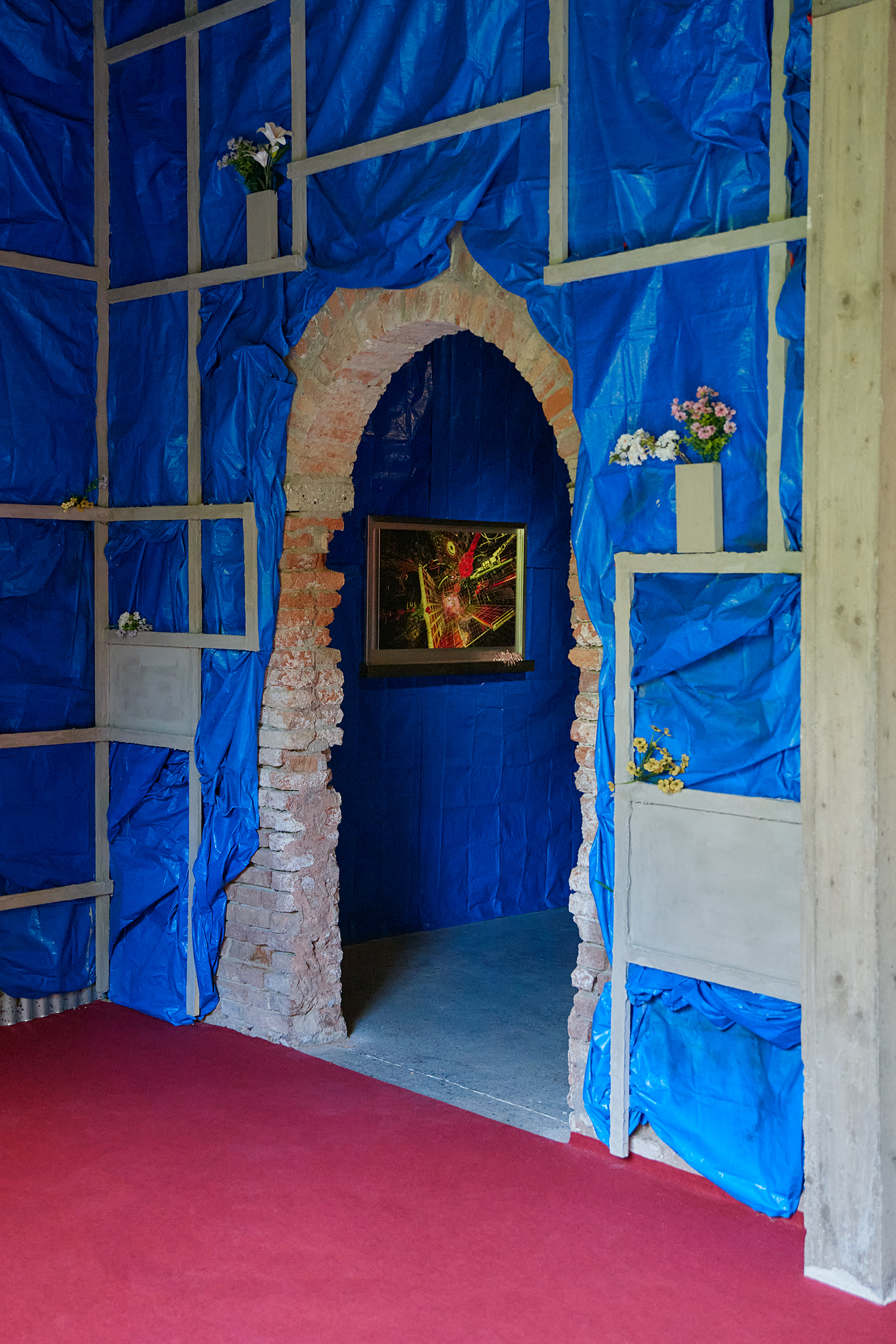
The pink of the plastic flowers on the skinny sceptre layered over the clock’s front face is brash in its brightness and clashes with the blue of the tarps covering over the three walls surrounding it. The plastic sheeting backs the frame structure in front of it and the vases—both made from cast concrete—which hold more bunches of artificial flowers, in yellow, pink and white, as well as corrugated iron. The makeshift living quarters of those who inhabit cemeteries in Manila, one of the densest cities in the world, is a reference. I learn this, rather than recognise it, through talking to an invigilator. Filipino funerary rites are highly distinctive, and their inclusion as a reference point marks a point of departure and arrival for the work as a container and expression of diasporic transmission, the migration of meaning: what is to be read easily or not by the audience, the points of seeming contradiction which only appear as such because of the presumed universality of the gaze of whoever’s in front of it.
At once Bugarin + Castle strip and embellish. The bricks of the walls show through; the kind of red carpet laid especially for a queen’s visit covers only some of the floor. Walking from the outside onto it can only feel like I’m muddying the floor, traipsing in and grinding dirt down into the fibres. Its crimson strawberry is a plush colour, but underfoot it feels thin and scratchy, maybe having lost its cushion through repeatedly being trampled—or it’s just cheap and cheerful, and a bit rough.
At the other end of the room is a kind of reconstituted jeepney (Nocturnal Amusements), the vehicle which is widely used for public transport in the Philippines; repurposed relics of US colonisation (1898-1946), and famous for being hand-painted with ‘jeepney art’. Its inclusion places this sculpture in a constellation inclusive of Chila Kumari Singh Burman’s MyTuk-Tuk (2019), in which Burman installs another kind of vernacular vehicle—an auto rickshaw—decorated in ‘unexpected embellishments like wrapping paper from Nepal, gems from Sri Lanka, fairy lights, Indian stickers and giant plastic eyelashes.’ See also Jasleen Kaur’s 2021 Sociomobile, a red Ford Mk3 Escort Cabriolet XR3i with crocheted doily, and Trackie McLeod’s 2025 sculpture of a Nissan Micra spray-painted with Burberry print.
By distinction, while the jeepney is quoted in Bugarin + Castle’s work, it is not imported directly into the space. Instead, the materials are remixed into a sculptural intervention made from spray painted aluminium and steel, with a number plate, rear view mirrors, and headlights. Painted shushing women look out amongst signs reading ‘Are You Discreet?’, and graphic scores from the cemetery. It is punched through with another kind of receding passageway. But the window made by the rectangle that’s cut away doesn’t whirl into a dark recess like the clock. Instead, it uses some of the same visual trickery to place the diorama at a distance.
The diorama’s based at once on the Manila North Cemetery and an 18th century William Hogarth print of a shame parade, whereby a violent and raucous procession is used to punish those who have infracted normative social behaviour. Known as a ‘charivari’, the term is otherwise obsolete except in its official usage in regulations silencing the cemetery inhabitants in Manila during nighttime. Hogarth’s figures have been stripped of the sound-makers they wield in the print, and merged with the cemetery features. Shanty-style dwellings are crafted with the amateur modelmaker’s loving touch, including delicately painted details like houseplants, a basketball, individually painted items of laundry hanging to dry above one of the above ground concrete vessels for human remains. Miniaturisation demands an attentive hand to achieve finely honed details, making an overlooked or under-respected populace–the cemetery inhabitants–not only visible, but in such a way as to attract gaze. An otherwise cramped space which doesn’t benefit from a wide-angle or spaciousness is visible in a way not otherwise achievable except through Bugarin + Castle’s careful crafting. The diorama as a form in general usage educates the viewer about what’s not known, to preserve what’s deemed historically significant. It’s a niche kind of sculpture, and allows Bugarin + Castle to materially record, and make the setting worthy of attention; to materially resituate the audience in relation to a space which is in many ways unimaginable to many: the domestic mausoleum.
The inclusion of videoke and karaoke is an important one, as most family houses including those in the Manila North Cemetery have well-used machines. Despite being a central part of cultural and social life, karaoke is subject to the enforced silence of the cemetery inhabitants after nightfall–including the seizure of their equipment. Living under overzealous control measures like these, poverty’s survival crafts are makeshift, fuse what’s there and sometimes uncomfortably: a grave is also a pantry for inhabitants of the Manila North Cemetery. This kind of making through making-do inflects the elaborate production flourishes throughout, e.g. how they sometimes bunch together like the panels and metal sculptural overlays of the jeepney, how the tunnel going through it has been installed to squeeze through a doorway—where the diorama is displayed in the other room.
The twenty-minute film Submit to Sound bleeds into the space in tender strains of a ballad sung in the Filipino language Tagalog, concerning in part historic shaming parades and contemporary tensions of presenting in the world as queer and trans. In Submit to Sound, there are threads of story relating to a trans character Sadie who is undergoing training to feminise her voice. This is cut together with footage of the Manila North Cemetery, and figures seen through floorboards singing sad songs of a broad-shouldered woman who scream with her every step. The hazy hypersaturated colour-infected fragments of nocturnal narrative glow without cohering entirely. Nor do they resolve, but are collaged through visual rhymes and sometimes harsh cuts. What emerges: the protagonist’s fear as she is haunted by grinning malevolent doubles and evil entities, all played by Bugarin + Castle; the uneasiness and overwhelm of deliberately and methodically straining the body to perform other than its habits.
Vertiginous downward looking repeats throughout Submit to Sound, as Sadie sees eyes looking back up through the floorboard, softly singing or staring menacingly, or crawling slowly through a hatch. She falls through then lands amongst a charivari crowd with the instruments for their raucous and rough justice: ladles in hand, bells round their neck–the percussive trunch and clangs ring out.
The trapdoor is again at the centre of a print (Set Upon), nearby the five-channel screen installation. Centripetal force makes the blueprint-style render spin in a hurricane of snake forms, horoscope symbols emblazoned on the ceiling of Mount Stuart, on Bute in Scotland, alongside (I later learn) visual references to built and unbuilt archives in Manila and Edinburgh, and a rope seen during the film, dropped to help those below up. Nine exquisitely decorated nail extensions grip at the edge of the bottom right corner, with images of the charavari sound-makers carefully scratched into the varnish–echoing the claustrophobic, voyeuristic perspective of the final shots of Submit to Sound of Hogarth’s charivari goers resurrected into live action. If these nails belong to Sadie, she’s lost her grip and nine of her adornments–did she keep her thumb? Gravity and space whirl in snatches from the body of work are caught up in the print’s forced perspective which tunnels through the different parts of Shame Parade.
By these means, Bugarin + Castle engage ‘The Marvelous Arithmetics of Distance’: how poet Audre Lorde phrases ‘the different ways of seeing things depending on where we are standing; how distance alters our perception so radically’. The portals and vortexes of the clock, jeepney, film, diorama and the Set Upon print design and fabricate prototype spatiality where coordinates are as suspended as the weapon-clock sculpture, at moments temporarily settled like a house made of plastic sheeting; like an exhibition venue rented on a sinking, entirely artificial island, just for a season and for through-the-nose rates; like a burial plot, rented only by the half-decade, subject to being sold off again if no one visits—as they are in the specific cemetery to which the work repeatedly returns. While the specific destabilisation referenced is of experiences of transness and diasporic flitting, there is solidarity and insight offered to all who are unmoored from liveable life in the contemporary capitalistic hellscape: misunderstood, hollowed out, expropriated, unhoused, skint. By sheer tenacity, grit and the glowing trickery and ancient magic of the Scottish word glamour, Bugarin + Castle draft schematic lines of flight.
Text by Adam Benmakhlouf (@adambenmakhlouf) is a writer and artist who lives and works across Scotland. They are Lecturer in Fine Art in Edinburgh College of Art, University of Edinburgh. From 2021-26 they completed their PhD thesis titled ‘Attempts To Locate the Body Are Continuing’, a practice-led project in experimental writing on embodiment and collective organising, supervised by Professor Maria Fusco (principal) and Dr Johanna Linsley, in Dundee Contemporary Arts and University of Dundee, fully funded by the Scottish Graduate School of Arts and Humanities. New works from this project have been, or will be, presented in Dundee Contemporary Arts (2022), the Paul Mellon Centre (2023), Listen Gallery (2023), CCA Glasgow (2023), Manchester Whitworth Gallery (2024), Hospitalfield, Arbroath (2022-24), and the Journal for Creative Writing in Practice (upcoming, 2027). Adam’s essay ‘some perfumes smell foul’ opens a major new collection by thirty-three working class writers titled Bread Alone: What happens when we run out of working class writers? edited by Kate Pasola, which was released on the 9th of March 2026 in all major and independent bookshops, then immediately sold out its first run.